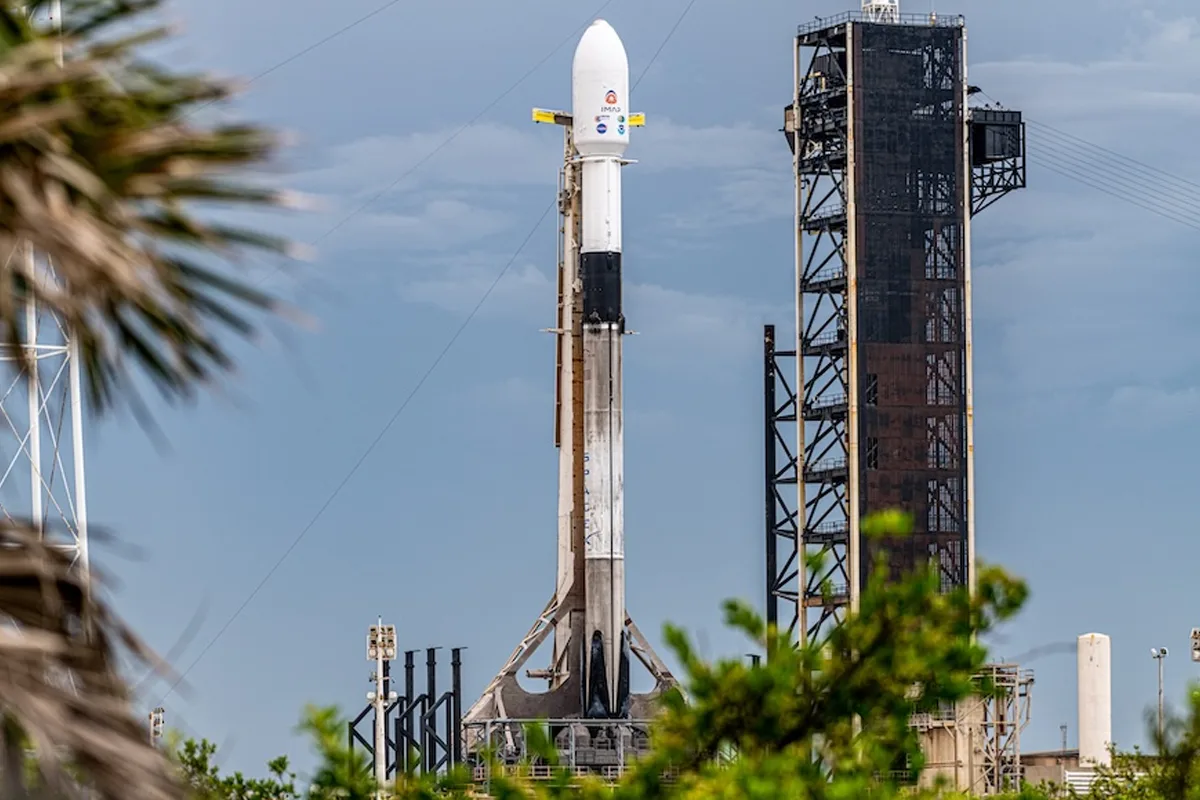
SpaceX Launch Today: 3 Probes Fly to Study Space Weather and the Boundary of the Solar System
Big news for science and space enthusiasts. Today’s launch by SpaceX stunned everyone yet again when a Falcon 9 rocket carried three distinct missions for NASA and NOAA to space. The rocket launched on September 24 at 7:30 a.m. EDT from the Kennedy Space Center in Florida. This rocket launch today demonstrated how determined humanity is to explore every corner of space.
What did today’s launch by SpaceX enable?
During this historic SpaceX launch today, SpaceX carried NASA’s Interstellar Mapping and Acceleration Probe (IMAP), the Carruthers Geocorona Observatory (CGO), and NOAA’s Space Weather Follow-On (SWFO-L1) spacecraft. The three missions have various goals, but they will all be striving toward a similar end—learning about space weather and studying its impact on Earth.
All three spacecraft are traveling to the same destination, known as Sun-Earth Lagrange Point 1 (L1). It is a gravitationally stable spot 1.5 million kilometers from Earth in the direction of the Sun.
IMAP Launch: A Mission to Study the Solar Wind and Heliosphere
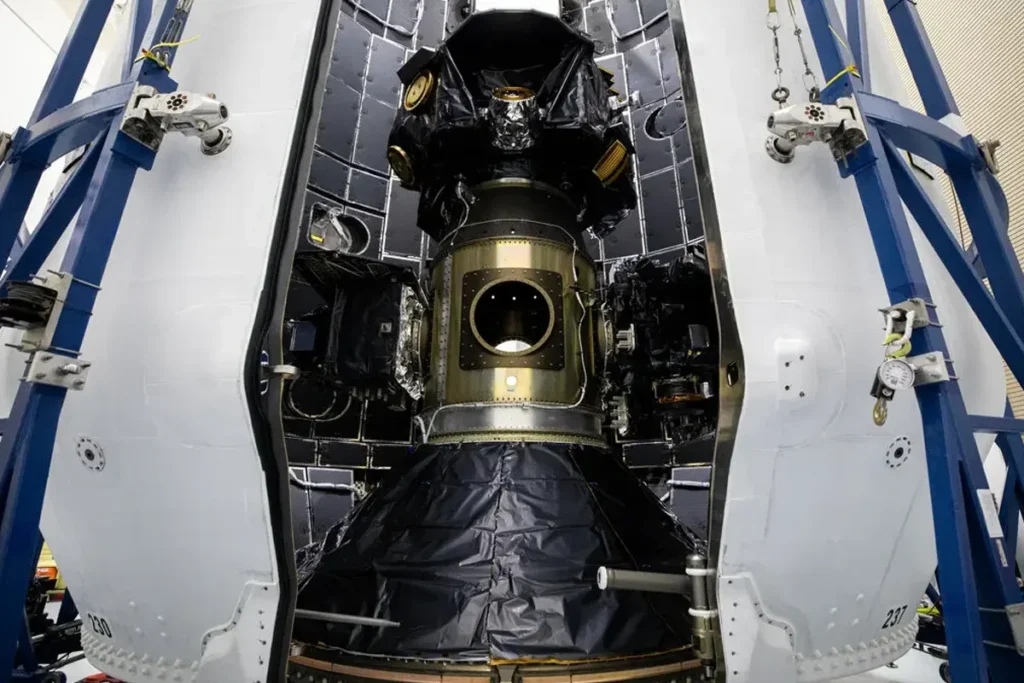
The main hero of this IMAP launch is NASA’s IMAP spacecraft. Constructed at a price tag of about $600 million, this spacecraft will track solar activity via its 10 instruments and demystify the secrets of interstellar dust. IMAP will also conduct detailed studies of the solar wind, a constant flow of charged particles emanating from the Sun.
Another primary goal of this mission is to chart the heliosphere—the bubble that confines our whole solar system under the domination of the Sun’s solar wind and magnetic field. This information will be extremely useful to scientists, as it will tell us how our solar system is shielded from galactic radiation.

IMAP will be a shield for astronauts.
IMAP will not only carry scientific data, but also act as a protective shield for astronauts. Radiation poses a major challenge for NASA’s Artemis program, which will send humans back to the Moon and, in the future, to Mars. Nicky Fox, associate administrator for NASA’s Science Mission Directorate, said: “Radiation exposure is a real threat for astronauts. Humanity has only been protected by the magnetosphere until now, and as we move beyond this shield, missions like IMAP will keep us safe.”
CGO and SWFO-L1: The Connection Between Earth and Space Weather
Yesterday’s SpaceX launch also launched IMAP to orbit. The first is the Carruthers Geocorona Observatory (CGO), which will analyze the outermost region of Earth’s atmosphere—the exosphere. This miniature satellite will photograph faint ultraviolet glows to see how space weather affects our world. This mission follows on from the era of Apollo, when these measurements were first made on Apollo 16.
The second mission is NOAA’s Space Weather Follow-On L1 (SWFO-L1), which will monitor solar storms. This will be an early warning system of sorts that will assist in safeguarding satellites, astronauts, and even our terrestrial power grids.
Successful Landing of SpaceX Rocket
Another feature of today’s rocket launch was the successful return of the Falcon 9 rocket. The first stage of the rocket landed safely in the Atlantic Ocean on a “Just Read the Instructions” droneship only nine minutes from its launch. This particular booster has previously flown for an Amazon Project Kuiper satellite mission.
This was the 120th Falcon 9 flight this year, with more than 70% of these missions dedicated to building the Starlink satellite constellation. This clearly demonstrates the scale of SpaceX’s space work.

Space Weather and the Future of Human Civilization
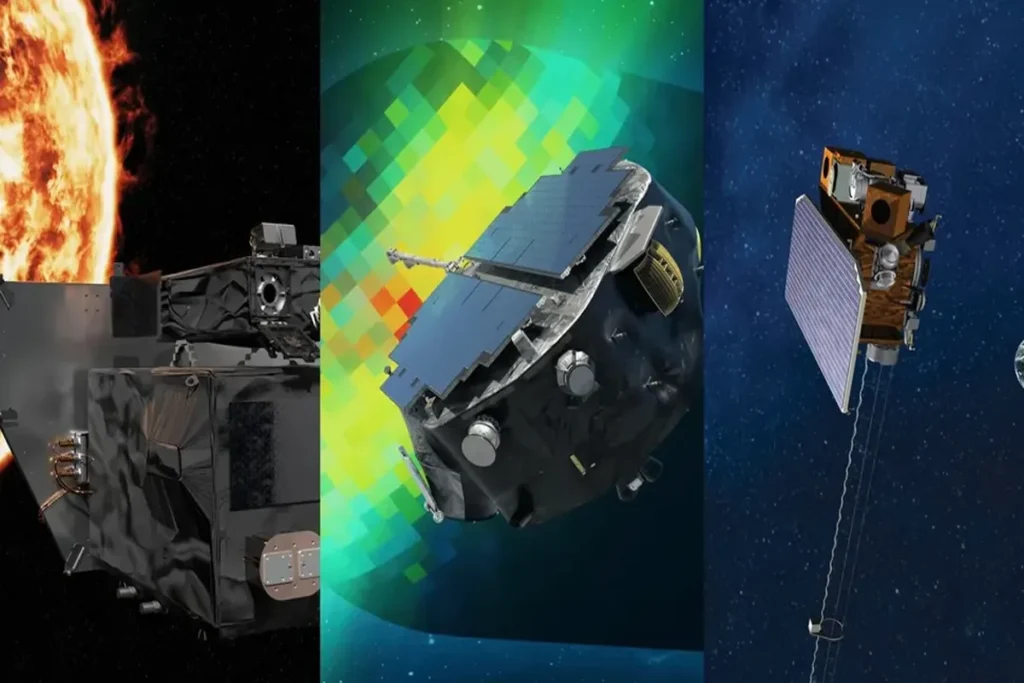
As NASA and NOAA scientists, these missions are not only a scientific breakthrough but also a survival technique for the human race. In order to survive missions to the Moon, Mars, or even other deep space missions, precise information regarding space weather and the heliosphere must be known.
Joseph Westlake, head of the heliophysics division at NASA, explained: “Missions such as IMAP and Carruthers prepare us for both near-term effects from the Sun and exploration into deep space.”. This research will create a resilient society that understands how to live with its star.”
IMAP’s instruments will study the complete lifecycle of particles—from ejection from the Sun to interaction in space and return. This will enable accurate space weather predictions. NOAA’s SWFO-L1 will also improve day-to-day operational forecasting, allowing us to protect our satellites and power systems.
Conclusion
SpaceX launch today’s is a reminder that humanity explores space for both curiosity and survival. Missions like IMAP, CGO, and SWFO-L1 will not only teach us, but also protect us—whether on Earth or on new destinations like the Moon and Mars. This launch is another step toward a futuristic world where humans can confidently travel beyond the boundaries of our own solar system.
Disclaimer:
The content of this article is for educational and informational purposes only. Official updates on space missions and data should always be verified with official sources from NASA and SpaceX.
Also Read
IREN Stock Surges as Nvidia and AMD GPU Deal Expands AI Cloud Capacity